They asked for a terminal. We gave them a city service.
Context
A major Italian public energy utility needed to replace its aging street electrical cabinets with a new-generation smart enclosure. The brief was technical: better materials, smarter grid integration, updated specifications.
Why this mattered
These cabinets sit on some of the most visible urban real estate a city has, every street corner, every neighbourhood, every hour of the day. And they're currently invisible, because they offer nothing to anyone who isn't fixing them. Solving only the engineering brief would have meant replacing one forgettable object with a newer forgettable object.
Constraints
This was a concept-stage engagement built from the technical brief and expert input, not from direct citizen research. That research is the planned next phase, once the concept moves toward real deployment.
What I discovered
Before questioning the brief, we looked at the object itself the way the people who actually touch it every day experience it: maintenance operators working in all weather, often in cramped or awkward physical conditions the existing cabinets had never been designed around. That physical UX lens was the opening.
The same location that made maintenance awkward was also, unused, one of the most exposed surfaces in the city.
From there, the team's reasoning shifted from what the cabinet contained to where it sat. Every one of these enclosures occupies a fixed spot on a street corner, visible and physically accessible to anyone who walks past, all day, every day. And yet almost none of that exposure was doing anything for anyone except the handful of people who opened the panel to fix something inside. If the enclosure could be rethought for the people maintaining it, the same location that made maintenance awkward was also, unused, one of the most exposed surfaces in the city.
Key decisions
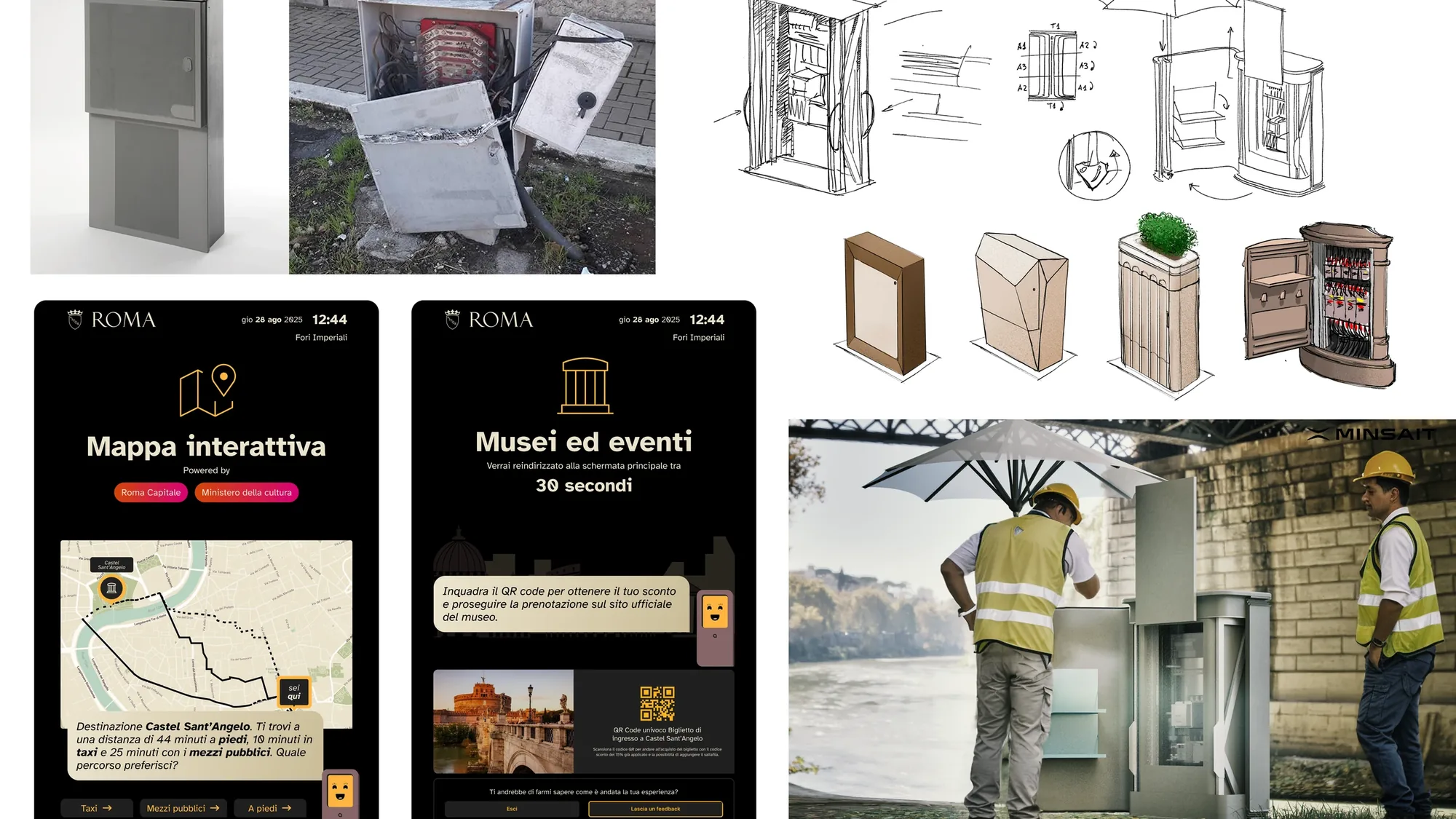
The client asked for a terminal box. We proposed a city service. The physical redesign for operators, better access panels, integrated shelving, weather protection, became the base layer of something bigger: a phygital object combining the physical enclosure with a digital layer of wayfinding, transit information, local city services, and emergency access, configurable by neighbourhood. It's the same object, doing its original job better, while also becoming useful to the thousands of people who walk past it without ever needing to open it.
We also brought monetisation into the concept early, without waiting to be asked. Space on a city-wide network of street cabinets has real value to municipalities and local businesses, and building that in from the start meant the concept had a path to funding itself, not just a design proposal asking for budget.
Trade-offs
Simpler, cheaper physical configurations were on the table early on. We set them aside because they couldn't support the range of services the concept depended on, a smaller, single-purpose enclosure looks cheaper on paper but forecloses the digital layer that makes the whole idea worth doing.
Solution
The final concept is a modular phygital cabinet. The physical layer solves the original engineering brief and the operator experience. The digital layer adds wayfinding, transit and local information, and emergency access, with the specific mix configurable per neighbourhood rather than identical citywide. On the client's request, we also developed anti-vandalism proposals, both technological and behavioural, since the current cabinets are a regular target. A physical prototype was built to demonstrate the concept beyond renders.
Impact
The reframe held up past the pitch: anti-vandalism and monetisation, both raised early and unprompted, are now being developed further as part of the brief. A physical prototype was built to test the concept beyond renders.
My role
I worked on this reframe as part of a phygital team, alongside my design team and engineers on the client side, turning a technical terminal brief into a phygital city-service concept. Making the case for that shift, from morsettiera to city service, was a joint effort across design and engineering, not a solo pitch.
What's next
The next phase is user co-design, bringing real citizens and other stakeholders (delivery workers, emergency services, tourists) into refining the digital layer, alongside the deeper monetisation and anti-vandalism work the client asked for.